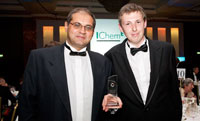
 Top Physics student wins European Physics award Top Physics student wins European Physics award
Neil Robinson, who graduated with a first class MPhys degree this summer, has won ‘Best Physics Student’ in the Science, Engineering & Technology Student of the Year Awards, the most important awards of their kind in Europe. Find out more. |
Putting the touch into touchscreens
A force-feedback system devised by Ian Summers expoits pressure-sensitive nerves, rather than stretch-sensitive ones. It is able to simulate the feel of a range of flexible materials, including silk, hessian and fur. Find out more.
|
Exeter astronomer wins international award for planet discovery
Dr Jenny Patience of the University of Exeter was part of an international team that captured the first-ever image of multiple planets orbiting a star other than our own. Find out more.
|
Exeter astronomer wins international award for planet discovery
Dr Jenny Patience of the University of Exeter was part of an international team that captured the first-ever image of multiple planets orbiting a star other than our own. Find out more.
|
Research has added to a growing evidence that several giant planets have orbits so tilted that their orbits can be perpendicular or even backwards relative to their parent star’s rotation. Find out more. |
A team from the School of Physics has helped set a new record for the most distant astronomical object yet observed: an explosion 13.1 billion light years away. The characteristics of the explosion, known as a gamma-ray burst, show that massive stars were already forming only 630 million years after the Big Bang. Find out more. |
The University of Exeter has been awarded £186,000 funding to help tackle one of the most fundamental problems in modern astronomy – when do stars and planets form and how does it happen? The funding, which has been awarded by the Science and Science and Technology Facilities Council (STFC), will support high performance computing projects conducted by the University’s Astrophysics Group. Find out more. |
Dr Sharon Jewell will use her fellowship as an opportunity to study human cells, which could help improve our understanding of major diseases like diabetes and cancer
Find out more. |
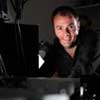 Shedding new light on brain disease Shedding new light on brain disease
Cutting-edge optical imaging technology will help develop smart nanodrugs to treat brain diseases like schizophrenia, depression and dementia. Dr Julian Moger has developed a new optical imaging technique to monitor the transport of particles less than one thousandth of a millimetre in size within biological tissues. Find out more. |
|
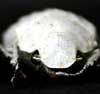
An obscure species of beetle has shown how brilliant white paper could be produced in a completely new way. The team has taken inspiration from the shell of the Cyphochilus beetle to understand how to produce a new kind of white coating for paper. Find out more.
|
|
A researcher from the School of Physics has helped to find a way to use doughnut shaped by-products of quantum dots to slow and even freeze light. The research opens up a wide range of possibilities from reliable and effective light based computing to the possibility of ‘slow glass’. Find out more.
|
|
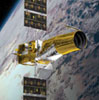
The CoRoT satellite has discovered a planet only twice as large as the
Earth orbiting a star slightly smaller than the Sun. It is the
smallest extrasolar planet (planet outside our solar system) whose
radius has ever been measured. Find out more.
|

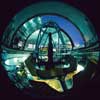 Exeter astronomers help set astronomy record
 Funding boosts astronomy research
 Quantum doughnuts slow and freeze light at will
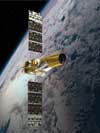 European team finds smallest transiting extrasolar planet ever